Sunday, October 11, 2015

Where am I? Part 3: The Field


It's been a while since I've posted and I have a lot to catch up on. In the past month, I've been working to find answers to some of the questions that were raised during the residency. In some cases, the answers revealed themselves. In other, they remain elusive.

One thing that I'm continuing to work through is exploring landscape through personal connection. So far this semester the imagery in my work was limited to my grandmother's back yard, but I'm beginning to expand a bit, moving forward in time from early childhood to adolescence and the end of childhood. That brought me to my family's move to rural Georgia when I was in middle school. Although I had a rather introverted childhood, I felt especially isolated during that time. One of the most vivid (and pleasant) memories I have is spending time reading and daydreaming while sitting in the middle of the field at the top of the property. It was an extremely rich, sensory experience. I distinctly remember the smell of the wind, the sound of cicadas, the dust rising up from the occasional car driving down the dirt road and the way the lavender wildflowers swayed in the breeze. The contrasting feelings of near isolation while also being connected with my surroundings remain with me.

Also, with this sand painting I numbered the images using the orthographic projection method I discussed earlier: 1-front, 2-back, 3-left, 4-right, 5-top, 6-alternate. Since I cannot photograph the painting from underneath (yet), I use an alternate view, in this case from the top, as a substitute for the sixth image. The 7th image is a bird's eye view of the entire work, for documentation purposes only, which will only be shared on this blog. I've been thinking a lot about the fact that these works will never been seen by the public except through the images I take of them. I would like to use my role as liaison between art and viewer more to my advantage. The work itself is an exercise in ephemera, its documentation, and sharing a fleeting moment with the viewer through the image. So the viewer, will experience my imaginary landscape much like an actual landscape; from a particular point of view, instead of all at once. It is my hope that will help create a more intimate connection between the viewer and the image and dissolve the separation between the two.


Monday, September 14, 2015

Landscapes & Relics


I've been playing around with the idea of adding permanent sculptural objects to my temporary installations. I would like to create a dialogue between natural material and man-made (or in this case "woman-made" relics. These biomorphic forms are intended to be ambiguous, at the same time referencing bodies, organic structures, land forms, or abandoned artifacts. I have always been attracted to working with multiples, building increasingly complex patterns out of simple shapes. These forms are made of cast porcelain. I love the interplay of light on the surface of unglazed porcelain. Its color and texture bears a resemblance to bone, stone, and fungi. 

I am working with porcelain slip for the first time and figuring out what needs to be addressed as I go along. From this first set of forms, I realized that I need to experiment with different methods of burnishing the clay before I fire it to improve its surface texture. I also found that I shouldn't be afraid to conceal parts of the form under sand. When I built unfired clay structures to submerge in sand, I thought the interplay between what was revealed and concealed was very interesting. I don't feel that this first attempt in using permanent sculptures was as successful. Maybe because I spent so much time in the process of sculpting the form, creating the mold, casting and firing it, I was a little more reluctant to cover it up.


Saturday, August 29, 2015

Landscapes into Ruin


I like the way the Ruin series is developing. Having an unplanned starting point where I have to develop the work intuitively is something that I have come to enjoy. In some ways I feel this series is more successful than the planned work that it’s derived from. Looking for ways to reference time and a sense of loss, I’ve been considering combining the images from this series with images of the original work, show them as diptychs. 

I also made a new discovery, orthographic projection. When I first started working on post-residency sand paintings, I made a decision to depict each landscape through six photos. The decision was instinctual. Being drawn to multiples of 3, I thought 3 views were not enough, but 6 would give the viewer a more accurate sense of the piece. Orthographic projection is a method for making a 2D representation of a 3D object. It includes 6 views: top, bottom, left side, right side, front, and rear. When photographing my work, I have starting using this method as I choose camera angles. This will give me a tangible guideline to use when pairing the images into diptychs.


Friday, August 28, 2015

Where am I? Part 2: The Creek


There are a number of images that come to my mind when I think of my childhood home. My grandmother has a large back yard that is mostly comprised of lawn but also has a wooded area. When I was a child, my great-grandmother kept a large garden in the partial shade of the tree line. I have memories of watching her tend the garden. The neatness of the rows she made by digging with a hoe fascinated me. I was also particularly drawn to the scents of tomatoes, pepper, and watermelon that you can only experience from witnessing them ripen. She also grew collards, yellow squash, eggplant and okra. My most vibrant visual memories of the yard include swarms of fireflies and the shimmer of sunlight on the tree leaves blowing in the wind. The taste of fruit and nectar from blackberry and honeysuckle bushes growing along the fence also made lasting impressions. These are all topics that I aim to develop into work. 

Nevertheless, the work that I’ve completed so far has focused on one image, the creek that flows through the very rear of the yard. Beyond the fence, there are dozens of very tall trees, a small hill that seemed like a mountain to me as a child, and a creek at the base of a deep ravine. It seemed to me, at the time, to be as close to wilderness as one could get. Thinking back on it now, my grandfather always kept it raked and free of leaves, so it was actually just as well kept as the lawn. He used to dump the lawnmower clippings in the ravine filling the air with the intoxicating scent of  freshly mown grass. I’ve recently read that the smell of cut grass is actually a distress signal released by the plant. I find the my sensory experience of the smell compared to what it actually signifies, an interesting contradiction. 

I’ve always had a dualistic relationship with that the area beyond the fence, a mix of fear and curiosity. I played in the shade of the trees often but I never once ventured down into the ravine for fear of snakes or not being able to climb back out. I thought it was incredibly beautiful, but ever distant. When my grandfather passed away, the area beyond the fence became over grown and almost inaccessible. To me that landscape has become a physical symbol of a significant loss. The loss of a central figure in my life and the connection to the landscape that person gave me access to.


Monday, August 24, 2015

Experiment Gone Wrong...Update


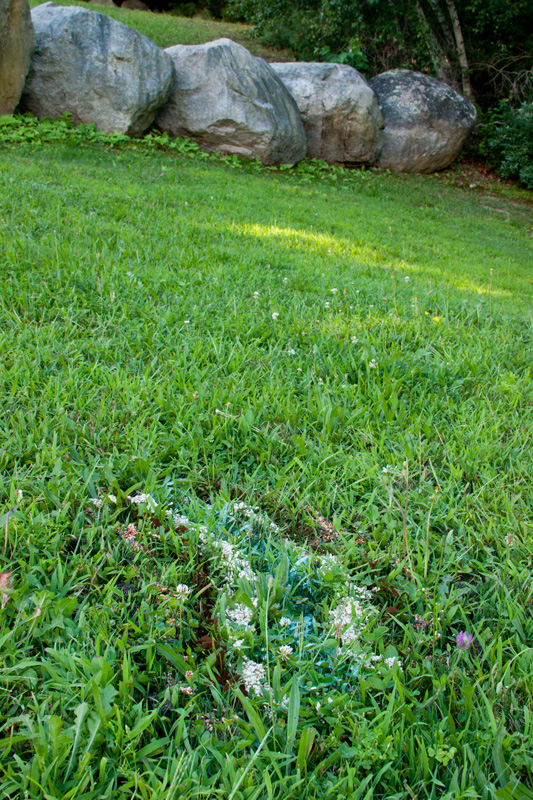
I'm continuing to work on the outdoor installations. Last Thursday, I created a third piece in a different location. For this work, I brought more than twice the amount of media than I did for the original ones. In addition to seed, I also used spent coffee grounds and ground rice. I was very happy with the result. The installation was more vibrant and could be easily seen from a distance but it also blends seamlessly with its environment. I also enjoy the way the grass seems to grow out of it.
.

I visited both sites regularly throughout the weekend. By Friday, I found that birds (and perhaps something a bit larger) had discovered the first installations. I was hoping for a series of photographs showing the destruction of the work more gradually over time. All the same, I think the resulting images are pretty interesting. Today, I interrupted a murder of crows feasting on the most recent work but sadly they would not let me get close enough to photograph them. 


Thursday, August 20, 2015

Experiment Gone Wrong


Sometimes ideas don't work out the way I envisioned them. For some time now, I've wanted to translate my sand paintings into outdoor installations. But, the more I thought about working outdoors the less appealing it seemed. I love the idea of making work that establishes a dialogue with nature but not the idea of using large amounts of sand colored with non-food safe dyes that could leach into the ground. Recently, I had an idea to use more eco-friendly materials, including bird seed, spent coffee grounds and rice colored with food-safe dyes. The other advantage to using bird seed is that (hopefully) the birds would eat it, creating some interesting opportunities to photograph the work in various stages of entropy and decay. After scouting for a place to conduct my first experiment, I found the perfect place. It was picturesque and near a marsh where it seemed likely to be frequented by lots of birds. I packed up some materials and set out to make it happen. After I started working, I realized very quickly that the media gets lost easily even in low-growing grass. It takes a lot of media (much more than I anticipated) to make the work stand out against the landscape. Revisiting the work a day later also revealed that birds have yet to discover my buffet of art and seed. The installation is disappointingly exactly as I left it. All is not lost however. I'll be back later this week with more media to give it another shot.


Wednesday, August 19, 2015

What is ephemeral? Part 2


There is something that really appeals to me about these ruined sand paintings. I haven't quite put my finger on it. It could be the idea of having to destroy something meticulously made and orderly to create something that has a natural beauty and effortlessness that the original never had. I enjoy the way the colors and textures mix so much that with this piece, I decided to use only neutral-colored sand to build the patterns surrounding it. I also tried to keep the pattern simple to emphasize the shape and colors of the ruined areas. The forms, depth, and color in this work seem more painterly and landscape based to me that its predecessor.