Showing posts with label studio. Show all posts

Monday, October 3, 2016

Mapping Out the Semester: October


Week One:
Complete papier-mâché landscape forms, sand and gesso
Complete editing photos for transfer and design collages for all 4 forms
Experiment with photo transfer techniques on board
Edit and print photos for quilting
Make corrections to Isaiah's inventory transcription
Re-record corrected inventory
Pour new set of collard molds
Shoot video of inventory drawings
Research for 4th paper

Week Two:
Begin photo transfer onto papier-mâché forms
Complete editing photos for transfer and design collages for all 4 forms
Cut photos and create collaged compositions for quilts
Continue work on inventory drawings
Conduct my own (workspace) inventory, record
Begin casting collards (if molds are dry)
Pour mold for Chattahoochee river
Hand casts based on mom and grandma's photos

Research and write paper

Week Three:
Complete photo transfer onto papier-mâché forms
Sew collaged compositions for quilts
Print inventory photos
Complete inventory drawings
Edit inventory recordings
Continue casting collards
Create Chattahoochee river papier-mâché forms
Continue hand casts based on mom and grandma's photos

Write and proof paper

Week Four:
Paint and texture papier-mâché forms
Continue collaged compositions for quilts
Work on installation for residency
Edit inventory recordings
Continue casting collards
Layer paper strips on Chattahoochee river papier-mâché forms
Continue hand casts based on mom and grandma's photos, research and try new material

Rewrite and complete paper


Thursday, September 1, 2016

Mentor Meeting One


Books
Monstrous Intimacies by Christina Sharpe
How to See a Work of Art in Total Darkness by Darby English
Only Skin Deep: Changing Visions of the American Self by Brian Wallis
The Carolina Rice Kitchen by Karen Hess
The Things They Carried by Tim O'Brien

Artists
Willie Cole (specifically Ironing Board Print series)
Latoya Ruby Fraizer
Janet Cardiff
Marcus Coates (specifically Birdsong)
Simone Leigh
Moana Hatoum
Allora & Calzadilla (specifically Returning a Sound)
Andrea Buttner
Goshka Macuga

Things to Consider
Cooking and the qualities of food
Give yourself permission to be messy, What role could that play?
Shared experience
Trauma
Cookbooks and the idea of a meal
Mapping/Homesteads
Spend time with objects and determine what feels the most meaningful
Bookmaking can be a way to put all the elements together
Consider ways to represent objects other than photography
Research based Practice

Mapping Out the Semester: September


Now that I'm back home and in the studio I need to focus on the process of making quickly. I have a lot of time to make up.
  • Continue daily writing and begin drawing exercises
  • Begin sketching ideas/collecting installation materials
  • Continue recording sounds and start recording new written narrations
  • Continue photo work
  • Decide where to print photos and which paper/printing process to use
  • Experiment with sewing "quilted" photo collages
  • Start thinking installation methods for photo
  • Brainstorm methods for using the Sunprint cyanotypes I made in Georgia
  • Think about how to use grandma's old encyclopedias. (collage, leaf pulp, casting, etc.)
  • Pulp and dye 1 batch of paper for casting per week (I wasn't able to procure as many library cards as I had intended, so I should continue looking for a new source in Rhode Island)
  • Make molds of new forms
  • Cast 1 set of collard leaves per week
  • Create at least 2 collages per week 
  • Make 4 shell pieces
  • Make 2 papier-mache sculptures

Sunday, August 7, 2016

Mapping out the Semester - August

Grandma in her backyard (c. late '80s)
While in Georgia...
  • Continue daily writing
  • I haven't been drawing as much as I had originally intended so I plan to begin this exercise in the next week
  • Continue adding daily entries into Commonplace/reflectionnaire book
  • Complete recording sounds/narration/interviews in Georgia
  • Complete 3 photograph series: hand portraits, homesteads, Harris County photo essay
  • Compile archived/scanned photographs: family portraits, family and place
  • Collect and scan archival documents
    • census records
    • birth/death/marriage certificates
    • any documentation of family in Harris County
  • Create at least 2 collages per week 

Once back home in Rhode Island...

  • Start researching video/audio techniques
  • Make clay sketches for gestural sculptures/consider mold-making
  • Make 4 shell pieces
  • Make 2 papier-mache sculptures
  • Pulp and dye 1 batch of paper for casting per week
  • Cast 1 set of collard leaves per week

Thursday, July 14, 2016

Mapping out the Semester - July

The beginning of Grandma's backyard
I love lists and I'm very excited about going back to Georgia this summer to visit family and friends. This trip will also grant me the opportunity to conduct some research and start projects that have been on my mind since last fall. Here is a general outline of what I want to accomplish over the next few weeks.


  • Create a studio plan for the semester
  • Get into the habit of writing every day
  • Start Commonplace/reflectionnaire book (add to it daily)
  • Find source for new library cards
  • Create at least 2 collages per week
  • Make a list of sounds to record while in GA
    • start recording
  • Decide which plants to make molds of while in GA
    • make molds
  • Sketch ideas for 3d collard work
  • Collect and scan archival images of my grandmother's backyard
  • Begin new photo series
    • establishing views and details of landscapes
      • grandma's backyard
      • mom's backyard
      • ancestral home in Harris County
    • hands of the women in my family at work and at rest
    • landscape/self portraits

Saturday, May 7, 2016

Mentor Meeting Notes


Artists
  • Arthur Dove 
  • Bryon Kim 
  • Isamu Noguchi 
  • Leonardo Drew 
  • Rose Marie Trockel 
  • Dario Robleto 
  • Whitfield Lovell 
  • Niki de Saint Phalle 

Books
Poetics of Space – Gaston Bachelard

Things to consider

  • Personal mapping/archaeology 
  • Use of a legend to read a map 
  • Keep drawing. The drawings are loose active and expressive. They are also a gift. A method for exploring ideas to add color to 3D objects without experimenting on the work. 
  • Get in the habit of making samples. Start to build a library of samples for material, surface, and color. Take detailed notes and include this information with the sample. 
  • In regards to the creeks, think about time and sequence 
  • Strive for forms that are richly processed (not just one thing) 
  • Make everything that comes as an idea, don’t try to make a consistent body of work, edit later 
  • Experiment with adding color to plaster works. It might make the work feel more complete and less familiar. 
  • In regards to the leaves, the specimen display emphasizes individualism and the content is more loosely implied. The monochromatic stacks are more mysterious. 
  • Consider how rigorous I have to be with personal/family content driven choices 
  • Where is the line between aesthetic and being faithful to memories? 
  • Expand the spectrum of work, include everything from diagrams/maps to objects 
  • Pedestals are the most neutral way to view a 3D artwork. Consider frames/pedestals as furniture contextualizing artwork within its time. Experiment with shelves/brackets, cabinets, tables, a set of shelves? 
  • Start experimenting with object arrangements. Look to modes of natural history display to start putting these objects together. 
  • If each object is one word, what sentence would they make when assembled together? 

Sunday, April 10, 2016

The Problem With Being Unique


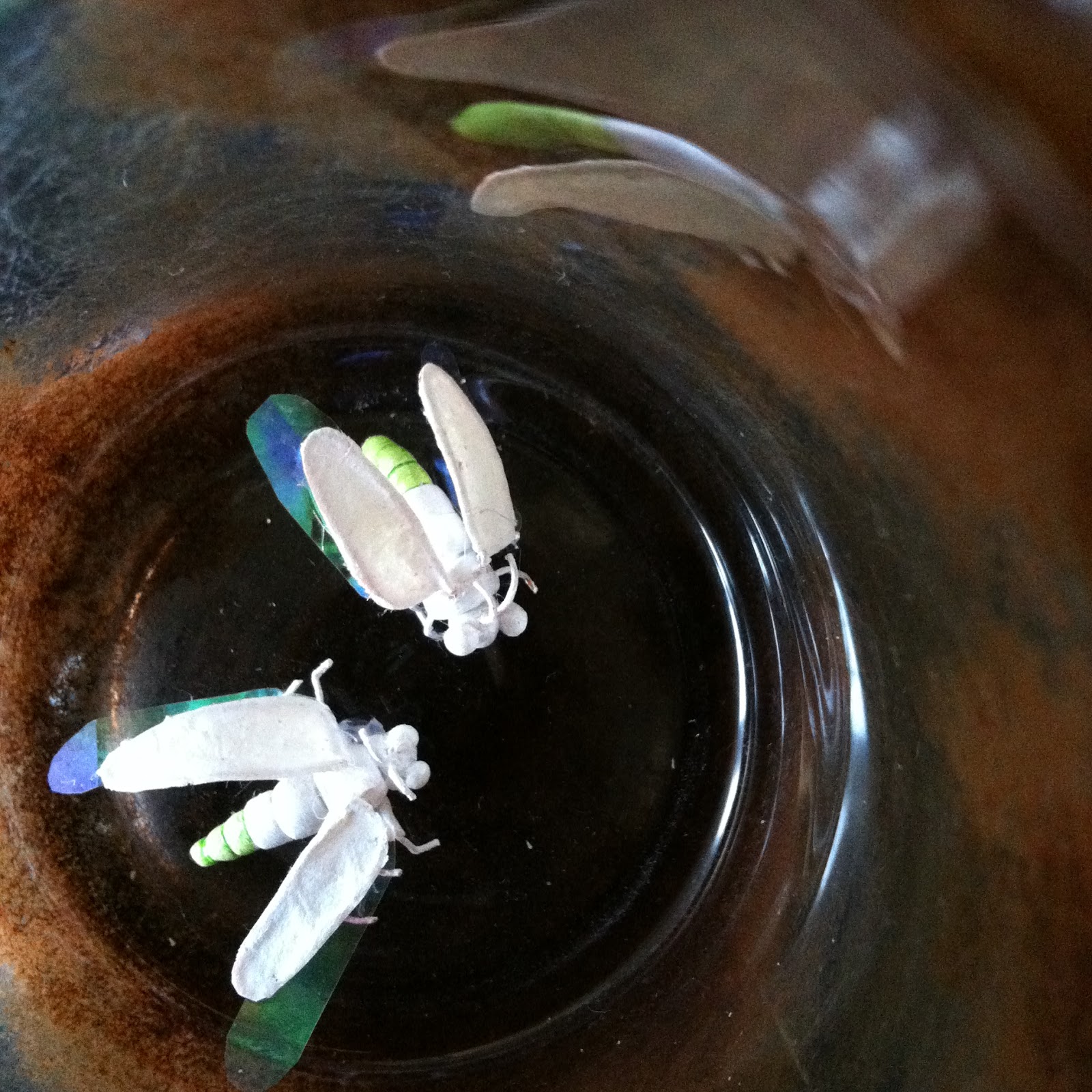
Almost finished with another lightning bug piece. This one is a mixed media assemblage. I have a couple of things left to resolve. How to finish off the lid/top? Considering either a coffee stained cotton cloth and twine or an aged and distressed lid. Like my other small objects, I also have to determine how best to display them.


Lightning bug detail


Friday, March 25, 2016

Where have all the lightning bugs gone?


 I've been journaling memories this semester and it is proving to be a valuable way to generate ideas for work. One thing that stood out to me was a memory of chasing and catching lightning bugs in my grandmother's backyard. I remembered there being so many. They seemed to hang like storm cloud among the low hanging branches of  trees, flashing as unpredictably as the bolts they are named after. Watching them swarm in my childhood was a near nightly occurrence at dusk during the summer and fall months. These days, I might see one or two of these flying beetles occasionally throughout the season, but can't remember the last time I saw a swarm of them. 

My musings led me to research what if their populations are dwindling. I found that they are, on a global scale and not just locally. As is the case with bees, scientists aren't exactly sure what is causing their disappearance, however there is one theory that increased light pollution disrupts their mating patterns. This revelation has let to several projects I'm currently working on. They deal with a fossilization of memories and personal/family narratives dealing with fireflies through objects. The first one is a plaster cast of the negative space between my hands, depicting the gesture of capturing a lightning bug. This is a sketch and not the final piece. I'm still working out the final form and the best way to construct it.


Tuesday, February 9, 2016

Experiments with Paper


I started off my studio practice this semester by experimenting with ways to dye library catalogue cards. My goal is to be more precise in the way I approach materiality in this body of work; reducing the pulp to a single material source is the first step. By comparing the results of dyed blended pulp vs. pre-blended torn paper, I sought to determine the best process for achieving accurate and vibrant color. I prepared two dye baths and allowed the paper to absorb the dye for several days. The pre-blended pulp dye bath produced more uniform and vibrant color but required a longer process to separate the pulp from the dye solution. Although the torn paper dye bath was resulted in more dull, uneven color, it was easier to separate from the dye solution. The torn cards also sat in the dye bath for a long time causing the paper fibers to break down too quickly during blending. This made it difficult to create pulp with bits of legible text. The next step will be to cast a set of leaves to determine the strength of the fibers and the durability of the leaf once it drys.


Torn paper in dye bath
Pre-blended pulp in dye bath
Pulp made from dyed torn paper

Friday, October 30, 2015

Painting Landscapes

Leaving the topography of the form white draws attention to the interplay between light and shadow. I think shifting the direction of the texture might create some interesting, unexpected patterns.
So a month ago I was really excited about these object/painting hybrids. A couple of weeks past and I finished the first set of forms and found myself ready to start painting. Then I ran into a problem. I realized that although I brainstormed and sketched the forms, I did not have a clear idea of what the finished, painted work would look like. I knew I wanted to do something with surface texture or pattern, but I wasn't exactly sure what. I was very happy with the forms themselves but once I started working on the underpaintings, not so much anymore.

I think I reached a point where I was overthinking these pieces. Since the concept behind them is rooted in childhood, I figured that I should try to recover a sense of play. I've resolved to work intuitively, which is something I normally reserve for my sculptural work. I immediately started building some new forms so I can try a different approach on each of them, working my way through the problem.

Started building some new forms to play with.


Finished the 3rd form and ready to paint.

Covering the first form with beads.

I like how the bead's iridescence gives the illusion of cloth.

Saturday, October 17, 2015

Progress is Slow but Steady


I've made progress on several fronts this week and look forward to seeing where things end up. I've spent much of the last few weeks feeling a bit lost and frustrated that some projects I'm working on are too different and don't relate to each other much. Today, I came to the realization today that I just need to think and worry less about where I'll end up.

One project that I'm working on is a series of object/painting hybrids. I started by building cardboard forms on a masonite base, then covering those forms with papier-mache. This week, I finished painting several coats of gesso on the first two. The built forms are inspired by imagery from the childhood landscapes I've been exploring in my sand work. The paintings I will use them for will focus on experimental surface treatments and abstracted patterning. It takes a while for them to dry in between layers of papier-mache. While I waited, I started building a third object also based on my grandmother's backyard. Today, I will finish applying the 2nd layer of paper.


I also made some progress on the coffee-batik panels this week. I was concerned about the edges which unravel erratically during the dyeing process. I intended for these panels to portray an immediacy that will be lost if I hem the edges. After some experimentation, I found that fraying the edges can be an appropriate solution. I've also learned that for future panels, I need to pay better attention to how I cut them to help the fraying process move faster and more efficiently. I have a rotary cutter for fabric I used a while back to make fabric collages. I plan on digging that out from its hiding place so that I can use it to make precisely vertical cut. While researching African textiles for this work, I uncovered a possible link between West African textile techniques and African American quilting traditions. I'm trying to get my hands on a book of the subject called Accidentally on Purpose to research it further.


Lastly, I'm working on collection of  slip-cast biomorphic forms used to create a pattern which will be partially submerged in sand. This project is moving more slowly than I anticipated because I'm working with molds that have to dry between castings. The first firings resulted in work with disappointing surface texture. For these newer pieces, I'm using rubber ribs to burnish the work while its leather hard before smoothing it further with a bit of chamois. 


Monday, September 14, 2015

Landscapes & Relics


I've been playing around with the idea of adding permanent sculptural objects to my temporary installations. I would like to create a dialogue between natural material and man-made (or in this case "woman-made" relics. These biomorphic forms are intended to be ambiguous, at the same time referencing bodies, organic structures, land forms, or abandoned artifacts. I have always been attracted to working with multiples, building increasingly complex patterns out of simple shapes. These forms are made of cast porcelain. I love the interplay of light on the surface of unglazed porcelain. Its color and texture bears a resemblance to bone, stone, and fungi. 

I am working with porcelain slip for the first time and figuring out what needs to be addressed as I go along. From this first set of forms, I realized that I need to experiment with different methods of burnishing the clay before I fire it to improve its surface texture. I also found that I shouldn't be afraid to conceal parts of the form under sand. When I built unfired clay structures to submerge in sand, I thought the interplay between what was revealed and concealed was very interesting. I don't feel that this first attempt in using permanent sculptures was as successful. Maybe because I spent so much time in the process of sculpting the form, creating the mold, casting and firing it, I was a little more reluctant to cover it up.


Saturday, August 29, 2015

Landscapes into Ruin


I like the way the Ruin series is developing. Having an unplanned starting point where I have to develop the work intuitively is something that I have come to enjoy. In some ways I feel this series is more successful than the planned work that it’s derived from. Looking for ways to reference time and a sense of loss, I’ve been considering combining the images from this series with images of the original work, show them as diptychs. 

I also made a new discovery, orthographic projection. When I first started working on post-residency sand paintings, I made a decision to depict each landscape through six photos. The decision was instinctual. Being drawn to multiples of 3, I thought 3 views were not enough, but 6 would give the viewer a more accurate sense of the piece. Orthographic projection is a method for making a 2D representation of a 3D object. It includes 6 views: top, bottom, left side, right side, front, and rear. When photographing my work, I have starting using this method as I choose camera angles. This will give me a tangible guideline to use when pairing the images into diptychs.


Friday, August 28, 2015

Where am I? Part 2: The Creek


There are a number of images that come to my mind when I think of my childhood home. My grandmother has a large back yard that is mostly comprised of lawn but also has a wooded area. When I was a child, my great-grandmother kept a large garden in the partial shade of the tree line. I have memories of watching her tend the garden. The neatness of the rows she made by digging with a hoe fascinated me. I was also particularly drawn to the scents of tomatoes, pepper, and watermelon that you can only experience from witnessing them ripen. She also grew collards, yellow squash, eggplant and okra. My most vibrant visual memories of the yard include swarms of fireflies and the shimmer of sunlight on the tree leaves blowing in the wind. The taste of fruit and nectar from blackberry and honeysuckle bushes growing along the fence also made lasting impressions. These are all topics that I aim to develop into work. 

Nevertheless, the work that I’ve completed so far has focused on one image, the creek that flows through the very rear of the yard. Beyond the fence, there are dozens of very tall trees, a small hill that seemed like a mountain to me as a child, and a creek at the base of a deep ravine. It seemed to me, at the time, to be as close to wilderness as one could get. Thinking back on it now, my grandfather always kept it raked and free of leaves, so it was actually just as well kept as the lawn. He used to dump the lawnmower clippings in the ravine filling the air with the intoxicating scent of  freshly mown grass. I’ve recently read that the smell of cut grass is actually a distress signal released by the plant. I find the my sensory experience of the smell compared to what it actually signifies, an interesting contradiction. 

I’ve always had a dualistic relationship with that the area beyond the fence, a mix of fear and curiosity. I played in the shade of the trees often but I never once ventured down into the ravine for fear of snakes or not being able to climb back out. I thought it was incredibly beautiful, but ever distant. When my grandfather passed away, the area beyond the fence became over grown and almost inaccessible. To me that landscape has become a physical symbol of a significant loss. The loss of a central figure in my life and the connection to the landscape that person gave me access to.


Monday, August 24, 2015

Experiment Gone Wrong...Update


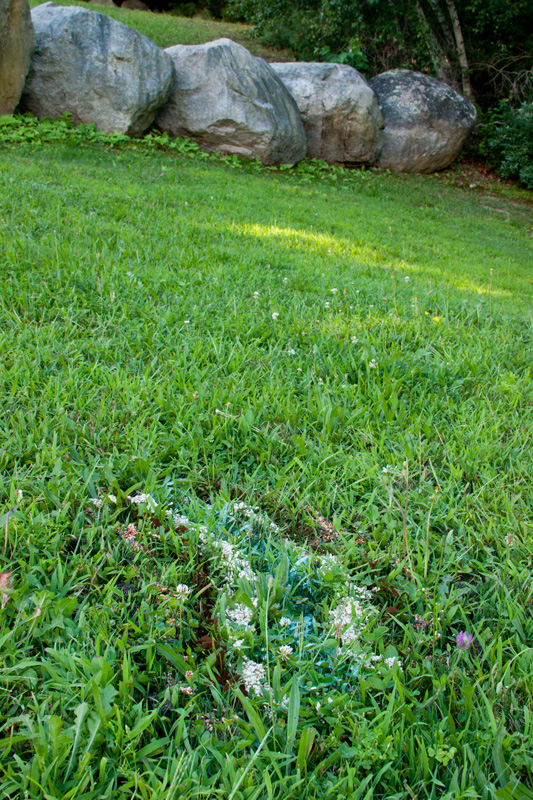
I'm continuing to work on the outdoor installations. Last Thursday, I created a third piece in a different location. For this work, I brought more than twice the amount of media than I did for the original ones. In addition to seed, I also used spent coffee grounds and ground rice. I was very happy with the result. The installation was more vibrant and could be easily seen from a distance but it also blends seamlessly with its environment. I also enjoy the way the grass seems to grow out of it.
.

I visited both sites regularly throughout the weekend. By Friday, I found that birds (and perhaps something a bit larger) had discovered the first installations. I was hoping for a series of photographs showing the destruction of the work more gradually over time. All the same, I think the resulting images are pretty interesting. Today, I interrupted a murder of crows feasting on the most recent work but sadly they would not let me get close enough to photograph them.