Saturday, May 7, 2016

Mentor Meeting Notes


Artists
  • Arthur Dove 
  • Bryon Kim 
  • Isamu Noguchi 
  • Leonardo Drew 
  • Rose Marie Trockel 
  • Dario Robleto 
  • Whitfield Lovell 
  • Niki de Saint Phalle 

Books
Poetics of Space – Gaston Bachelard

Things to consider

  • Personal mapping/archaeology 
  • Use of a legend to read a map 
  • Keep drawing. The drawings are loose active and expressive. They are also a gift. A method for exploring ideas to add color to 3D objects without experimenting on the work. 
  • Get in the habit of making samples. Start to build a library of samples for material, surface, and color. Take detailed notes and include this information with the sample. 
  • In regards to the creeks, think about time and sequence 
  • Strive for forms that are richly processed (not just one thing) 
  • Make everything that comes as an idea, don’t try to make a consistent body of work, edit later 
  • Experiment with adding color to plaster works. It might make the work feel more complete and less familiar. 
  • In regards to the leaves, the specimen display emphasizes individualism and the content is more loosely implied. The monochromatic stacks are more mysterious. 
  • Consider how rigorous I have to be with personal/family content driven choices 
  • Where is the line between aesthetic and being faithful to memories? 
  • Expand the spectrum of work, include everything from diagrams/maps to objects 
  • Pedestals are the most neutral way to view a 3D artwork. Consider frames/pedestals as furniture contextualizing artwork within its time. Experiment with shelves/brackets, cabinets, tables, a set of shelves? 
  • Start experimenting with object arrangements. Look to modes of natural history display to start putting these objects together. 
  • If each object is one word, what sentence would they make when assembled together? 

Sunday, April 10, 2016

The Problem With Being Unique


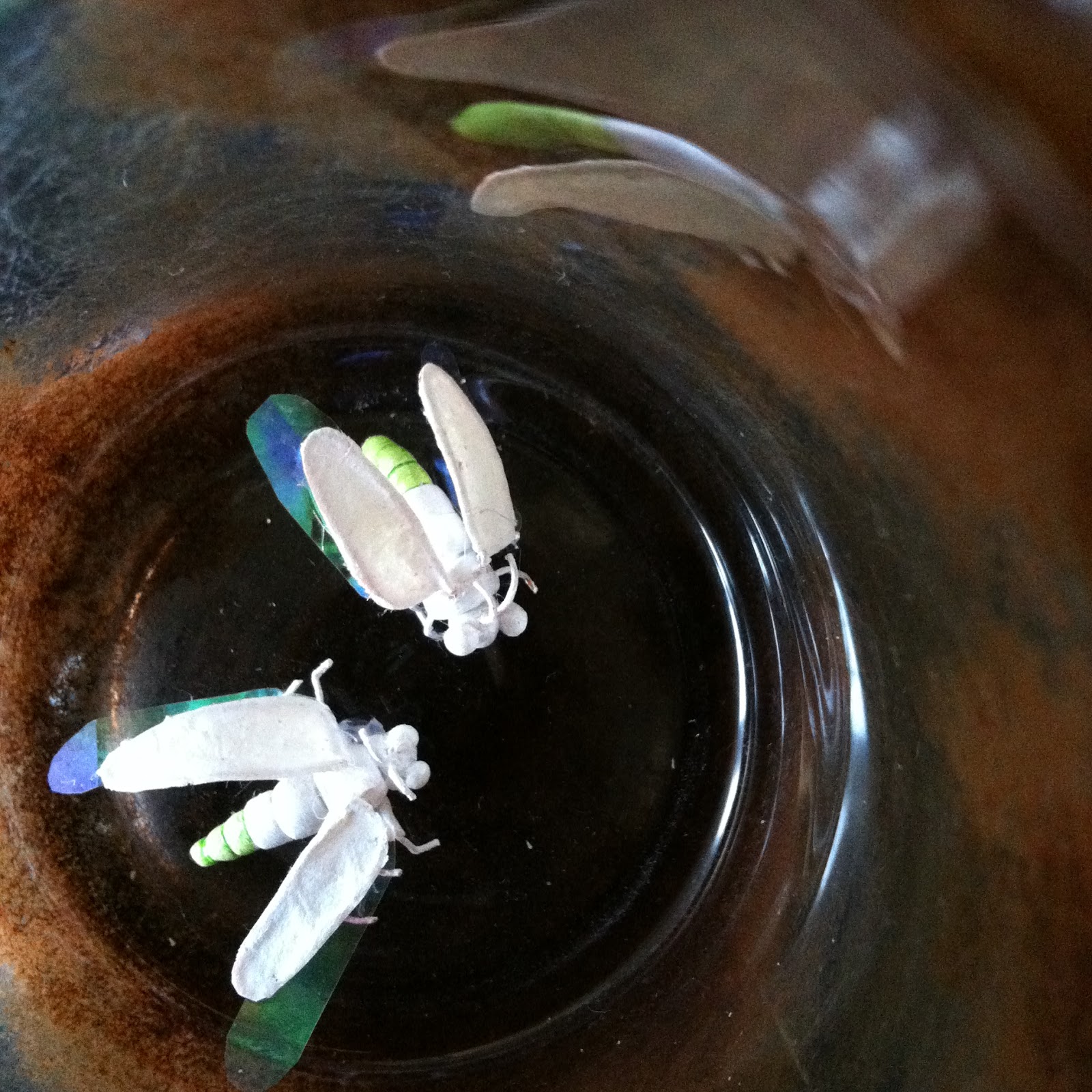
Almost finished with another lightning bug piece. This one is a mixed media assemblage. I have a couple of things left to resolve. How to finish off the lid/top? Considering either a coffee stained cotton cloth and twine or an aged and distressed lid. Like my other small objects, I also have to determine how best to display them.


Lightning bug detail


Bunches or Specimens


Lately I've been cleaning up the leaves and painting their veins. Trimming their edges of pulp that extended beyond the mold proved to be more difficult than I expected. Even using a sharp X-acto knife, the pulp fibers are so short that they tear very easily. 

I've been considering 3 different methods of display:

  • Pinning as a row or grid of specimens
  • Binding them in bunches with twine
  • Stacking them loosely in bunches


Pin detail


Twine detail


Friday, March 25, 2016

Where have all the lightning bugs gone?


 I've been journaling memories this semester and it is proving to be a valuable way to generate ideas for work. One thing that stood out to me was a memory of chasing and catching lightning bugs in my grandmother's backyard. I remembered there being so many. They seemed to hang like storm cloud among the low hanging branches of  trees, flashing as unpredictably as the bolts they are named after. Watching them swarm in my childhood was a near nightly occurrence at dusk during the summer and fall months. These days, I might see one or two of these flying beetles occasionally throughout the season, but can't remember the last time I saw a swarm of them. 

My musings led me to research what if their populations are dwindling. I found that they are, on a global scale and not just locally. As is the case with bees, scientists aren't exactly sure what is causing their disappearance, however there is one theory that increased light pollution disrupts their mating patterns. This revelation has let to several projects I'm currently working on. They deal with a fossilization of memories and personal/family narratives dealing with fireflies through objects. The first one is a plaster cast of the negative space between my hands, depicting the gesture of capturing a lightning bug. This is a sketch and not the final piece. I'm still working out the final form and the best way to construct it.


Friday, March 18, 2016

Veins, Dyes, & Display

Finished Khaki leaf
Finished Composite leaf
Finished Moss leaf
I've been finishing up painting the veins in on the paper leaves I made in February and casting new ones. The line quality and variation is improving. This semester my goal has been to create leaves that are less realistic, emphasizing transparency of process and material. These objects look less like actual leaves, making the increased verisimilitude of the stem and leaf veins a necessary element and an interesting contradiction. 


New Moss dyed pulp leaf

Sage dyed pulp leaf
I mixed two new batches of dyed pulp, in an attempt to cast leaves with more vibrant color and improved texture. I'm pretty happy with the results. One is a delicate moss green, the other is a deeper sage color. Both pulps have legible text, interesting variation in hue, and pick up greater detail from the mold. All of the new leaves are made entirely out of library catalog cards.


Detail of new Moss leaf
I've also been thinking about ways to display this work. I haven't completely ruled out pinning them to the wall as specimens but I'm not sold on it either. One option is to display them lying on a surface in bunches; the way they would be purchased or stacked after picking and washing.


Collard Bunch (display idea)
Detail of Collard Bunch (display idea)

Adding Depth


One of the things that came up in the first meeting with my mentor was to push the depth in my relief sculptures. Since I had already completed the structure for the 3 panel relief, I decided to make a couple of smaller pieces to work out potential structural issues. The original relief sculptures averaged about 1.5 inches deep, the two new ones are between  3-4.5 inches deep. 

I learned 5 things in this process:

  1. I'm more attracted to the undulating form and play of light in this work than its predecessors.
  2. I'm less enthusiastic about the edge, increasing the depth also makes the form appear more like a box. I need to consider the overall form as an object and not as confine it to a box/square.
  3. Exaggerating the depth of the form complicates the papier-mache process, making it more difficult to maintain strength and smoothness.
  4. In keeping with thinking of this work as sculptural objects rather than paintings, I should pay closer attention to how I finish off the back of the work.
  5. By painting the object the first, I can use glitter and sealer more efficiently. 


Tuesday, March 1, 2016

New Leaves

Moss pulp leaf no.6  

In the last couple of weeks, I have cast about 10 leaves from the pulp I made in early February. Half of them were made from the blended paper pulp and dyed moss green. Two were made from the torn paper pulp and dyed khaki green. The remaining leaves were made from a composite pulp using the remnants of the two dyed pulps and leftover cotton linter pulp from last semester. 

I've made some progress toward reaching the goals I set in January. I learned that the dye must be used in a higher concentration to more achieve more vibrant results. I also discovered that the blended paper pulp yielded the best results in terms of leaf texture and legible text. The color, however, was less than ideal. Once the pulp was cast, it dried to a hue that appeared more bluish-grey than green. The next step will be to experiment further with color and look for a new source for library catalogue cards. 

This week I will also paint in the veins, experiment with using ink instead of acrylic, and reinforce the back of the leaves with gel medium. The cardstock fibers do not create as strong a pulp as cotton fibers. Its also time to think about using different leaves and begin making some new molds.

Moss pulp leaf no. 2 

Khaki pulp leaf no. 2

Khaki pulp leaf no. 1

Composite pulp leaf no. 2

Composite pulp leaf no. 1